Roundtable “Towards Care Societies” hosted at Casa Amèrica Catalunya on February 26th
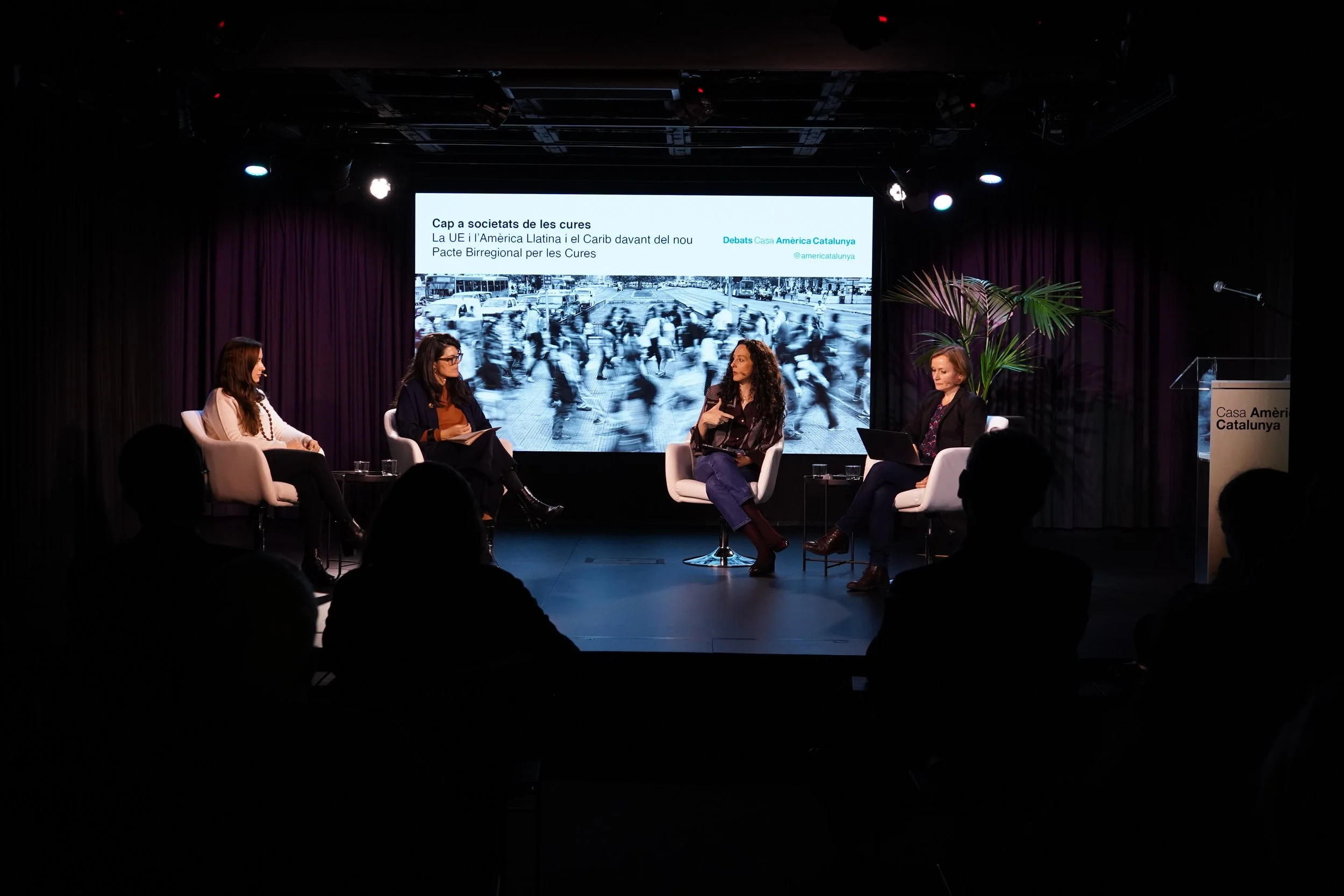
From left to right: Natalia Escoffier, Andrea Costafreda, Inma Alonso, Anna Barrera
On 26 February 2026, Casa Amèrica Catalunya hosted the roundtable Towards Care Societies: The EU and Latin America and the Caribbean in the Face of the New Bi-regional Care Pact. The event brought together leading voices from across the EU–LAC space to reflect on how both regions can work together to build fairer and more inclusive care societies.
Within the framework of the cooperation agreement between IBEI and Casa Amèrica Catalunya, and with the support of the MSCA Doctoral Network ‘LAC-EU’ and the Jean Monnet Network ‘EULAS’, the roundtable explored the scope and implications of the recently launched Bi-regional Care Pact. The Pact had been approved by the European Union and several Latin American and Caribbean countries at the CELAC–EU Summit of Heads of State and Government held in Santa Marta, Colombia, in November 2025.
Speakers underscored that the New Bi-regional Pact on Care represents a significant milestone in a long-standing, multi-actor process that has positioned care - as a human rights and gender equality agenda - at the heart of EU–LAC dialogues. Panellists highlighted the strategic importance of advancing this topic in the current geopolitical context, emphasising the crucial role of multi-stakeholder alliances, civil society networks and institutional coordination in shaping and sustaining this momentum.
The discussion also brought into focus the Pact’s added value in promoting care societies and co-responsibility, while identifying both challenges and opportunities for deepening its implementation in the years ahead. Participants stressed that translating political commitments into concrete policy action will require sustained cooperation, monitoring mechanisms and inclusive governance structures across both regions. The strong engagement from both in-person and virtual audiences further enriched the exchange, generating meaningful synergies with the ideas presented and reaffirming the relevance and timeliness of this bi-regional instrument.
The roundtable featured contributions from distinguished speakers:
Ana Güezmes García, Director of the Gender Affairs Division at ECLAC, participated through a pre-recorded intervention representing the Regional Conferences on Women in Latin America and the Caribbean. With a 35-year trajectory dedicated to advancing gender equality at the international level, she drew on her extensive experience at UN Women, UNFPA, WHO, PAHO and AECID, as well as her academic work in Peru. In her remarks, she centred on the role of the Regional Conferences on Women - the principal intergovernmental forum organised continuously by ECLAC since 1977, and jointly with UN Women since 2020 - in driving the gender equality agenda across Latin America and the Caribbean, particularly in the area of care. She also referred to the most recent Commitments adopted in Buenos Aires (2022) and Tlatelolco (2025), underscoring the synergies between these agreements and their contribution to ongoing bi-regional efforts towards a Bi-regional Pact on Care.
Anna Barrera, Director of Programmes at the EU-LAC Foundation, discussed the role of knowledge generation and dialogue in strengthening bi-regional relations. Drawing on her role at the Foundation as well as her extensive professional and academic experience in development cooperation and international relations, she outlined the main features of the Pact, its scope, and the key milestones that made this outcome possible. She reflected on the series of multi-stakeholder events that proved pivotal in the journey from the initial articulation of the idea of a Care Pact to its realisation in 2025, highlighting the EU-LAC Foundation’s key convening and articulating role throughout the process. In doing so, she situated the Pact within broader bi-regional efforts to advance multilateralism, democracy, climate and environmental action, and gender equality.
Andrea Costafreda, Director General for Development Cooperation of the Government of Catalonia, provided a regional perspective on cooperation and care policies, drawing on her experience in international organisations, public administration and civil society. She further enriched the discussion by connecting the Government of Catalonia’s priorities to the broader geopolitical landscape, highlighting the principal challenges ahead and suggesting potential pathways to deepen this agenda through a multi-stakeholder, gender-responsive approach.
Inma Alonso, Former Coordinator of the EU–LAC civil society working group, addressed the importance of civil society engagement and public care policies in advancing the objectives of the Pact, highlighting her longstanding involvement in advocacy and EU–LAC relations. She also mapped the articulation of the Civil Society Working Group’s priorities throughout the process, emphasising the role of coordination among diverse platforms and organisational networks. This collaborative approach, she noted, lent the process both analytical depth and multi-sectoral engagement, thereby strengthening the content and ambition of the Pact.
Leire Pajín Iraola, Member of the European Parliament since July 2024, offered reflections on the European dimension of the Pact and its relevance for sustainable development, global health and international cooperation. Drawing on her extensive experience in international relations, sustainable development, global health and international cooperation — both in her current role in the European Parliament and in previous senior public offices and positions within international foundations - she reflected on how the work culminating in the Pact engages with the European Parliament’s agenda. She underscored the strategic importance of the care agenda in the current geopolitical context and considered how ongoing efforts can consolidate and deepen the progress achieved to date. From this vantage point, she situated the Pact within a broader institutional and political framework, highlighting both its immediate relevance and its long-term transformative potential.
The session was moderated by Natalia Escoffier, doctoral researcher at the MSCA Doctoral Network LAC-EU (IBEI–UPF). As part of this bi-regional research and training programme, her work focuses on EU–Latin America and Caribbean relations and the policy debates that shape them.

Inma Alonso, Anna Barrera
If you wish to rewatch this fantastic event, you can find the full recording of the event here.